

Building

Connection and
Curiosity
Through STEM Education

With interactive experiences and digital tools, PLTW prepares students and teachers nationwide to thrive in STEM.

Project Lead The Way
Joel Kupperstein
Chief Product Officer
Vanessa Stratton
Senior Vice President of Instructional Development
Jason Rausch
Senior Vice President of Instructional Development
Sylvia Huff
Senior Vice President of Research
MISSION

Create a transformative learning environment and empower students to develop in-demand knowledge and skills necessary to thrive in an evolving world

INDUSTRY

Education/STEM

FOUNDED

1997

HEADQUARTERS

Indianapolis, IN

LEARNING AUDIENCE

PLTW teachers and students

Transformative learning
A

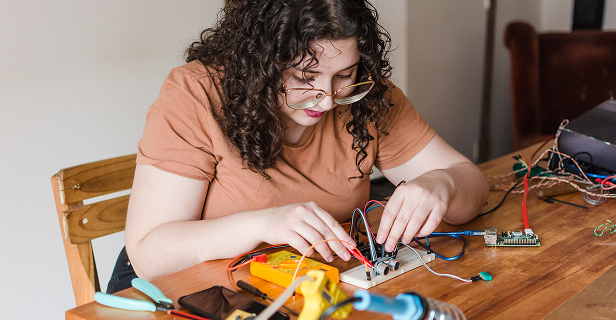
group of students gather around a robotics kit. They flip a switch, but nothing happens—the motor stalls, and the robot doesn’t move. Instead of frustration, the room buzzes with focus as students regroup, revise, and rebuild.

“We try to instill in our students that it’s ok to fail,” says Vanessa Stratton, Senior Vice President of Instructional Development. “It’s ok if you don’t get it right the first time. Our students are amazing problem solvers.”

Scenes like this play out every day in Project Lead The Way (PLTW) classrooms around the country.

The organization designs STEM experiences that remove learning barriers for students, pique their curiosity, and encourage their persistence. Serving 2.5 million students and over 100,000 teachers across the U.S., the nonprofit prepares pre-K-12 students for careers, college, and life by equipping them with the STEM knowledge, credential preparation, transferable skills, and confidence that they need to succeed.

Serving 2.5 million students and over 100,000 teachers across the U.S.

Online learning is integral to that work. Interactive simulations and virtual labs allow learners to explore complex concepts even when physical resources aren't available, while embedded assessments provide timely feedback to guide their progress.

“All of our learning experiences are delivered digitally, and either facilitated virtually or in person,” says Stratton. “We’re constantly thinking about how we can expand access for all of our students, and learning directly ties back to that mission.”
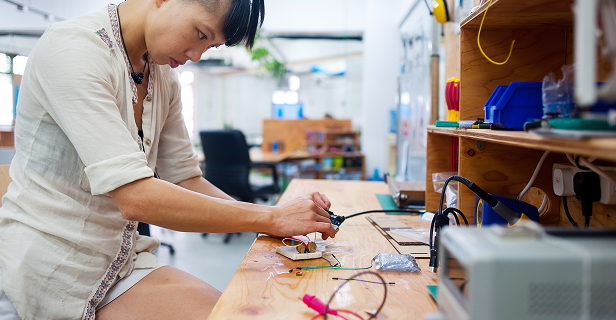
A person in a workshop building a motor with wires and batteries

Removing barriers, building community

Preparing its educators for success is just as critical. PLTW’s content is sophisticated and hands-on, requiring deep subject matter expertise to guide experiential learning effectively. Through a combination of synchronous and asynchronous learning, online and in person, the organization can prepare teachers consistently at scale across the entire country.

That structure also helps foster community, which is particularly important for teachers who may be the only STEM educator in their school.

“Our online professional development opportunities are transformative for a lot of our teachers,” says Jason Rausch, also a Senior Vice President of Instructional Development. “Many of them are still in touch with the people they trained with a decade ago. The community we’re building through learning allows us to create that environment.”

“E-learning is a tremendous avenue for improving our access and reach,” adds Joel Kupperstein, Chief Product Officer at PLTW. “It’s allowed us to deliver consistently high-quality training and instruction for both students and teachers—at scale, and with real impact.”

View the story as a PDF
Download PDF
[E-learning
has]
allowed
us
to
deliver
consistently

high-quality

training
and
instruction
for
both
students
and
teachers—at
scale,
and
with
real
impact.
Joel Kupperstein, Chief Product Officer
Adapting to evolving learning needs

A recent internal survey of over 4,000 PLTW teachers reflects that impact. 91 percent reported confidence in teaching their subject matter, and 72 percent said the training improved their effectiveness in the classroom.

91%

of PLTW teachers reported
confidence in teaching their subject mater

72%

of PLTW teachers said the training improved their effectiveness in the classroom

“Teacher satisfaction and self-efficacy are critical,” says Sylvia Huff, Senior Vice President of Research. “And they’re closely tied to student outcomes. When teachers are prepared and supported, students benefit.”

As STEM education continues to evolve, PLTW focuses on staying ahead by adapting its content, tools, and training to meet the changing needs of students and educators.

“The learning experience is changing quickly, and the number of different learning scenarios we need to support keeps growing every day,” says Kupperstein. “As we move forward, we’re focused on using learning to meet people where they are and to design content that works in any environment.”

A person building a robotic device on their kitchen table