
Training to

Transform Lives

UNOS uses flexible training to support
life-saving professionals in high-stakes environments.

United Network for Organ Sharing
Beth Coe
Learning and Development Manager
Samantha Settimio
Learning and Development Manager
Erica Inge
Education Team Manager
MISSION

To save and transform lives through research, innovation, and collaboration

INDUSTRY

Healthcare

HEADQUARTERS

Richmond, VA

FOUNDED

1984

LEARNING AUDIENCE

Transplant professionals and patients, UNOS employees

Saving and transforming lives
F

or the doctors, nurses, surgeons, lab techs, and other professionals who coordinate organ transplants, every moment counts—not just for procedures, but also for training.

“Transplant professionals might only have a few minutes in between patients to learn about an important policy update,” says Samantha Settimio, Learning and Development Manager at the United Network for Organ Sharing (UNOS). “Our training needs to meet them where they are at that moment with the exact information they need.”

Their approach to learning makes that possible.

“We have options in how we present our training,” says Settimio. “We could rely only on static documents or webinars, but we don’t. We choose e-learning because it allows us to do what’s best for our community.”

Two medical professionals wearing scrubs and smiling.
Training designed for precision

UNOS is one of the federal contractors that manages the nation’s organ and donation transplant system. While other organ donation matching organizations exist, UNOS, through its federal government contract, is the only one in the U.S. that collaborates directly with the transplant community, who shape policy. Then, the organization trains that community on how those policies impact their work.

“We are the only company in the United States that does what we do,” says Beth Coe, also a Learning and Development Manager. “That’s a role we take very seriously.”

The training UNOS delivers spans complex, technical content, including training to help transplant professionals navigate the organ matching system. Policy education, nuanced and tailored to individual organ systems, is another major component.


“This isn’t your average HR policy training,” says Settimio. “These are highly technical, high-stakes policies around organ transplants.”

The Education Team also regularly updates and streamlines courses. When a new education campaign is introduced, training is broad. But once it becomes routine, courses are distilled to the essentials.

“When we launch a campaign, the content is wide-ranging to cover all the angles,” says Erica Inge, Education Team Manager. “But over time, that information needs to be condensed. If a learner only has 15 minutes, we want them to get what they need in that time.”

View the story as a PDF
Download PDF
If
a
learner
only

15 minutes,

we
want
them
to
get
what
they
need
in
that
time.
Erica Inge, Education Team Manager
A connecting, clarifying force

To help learners grasp concepts quickly, the Education Team creates customized case studies, scenarios, and simulations. “Interactivity makes the concepts realistic to the learner, even if they’re introduced online,” says Inge. “It helps learners recognize complex situations in real life and respond to them correctly under pressure.”

The Education Team creates customized case studies, scenarios, and simulations.

It also serves as an invaluable communication tool. “Our learners are spread across the country,” says Coe. “E-learning helps us deliver consistent, accurate updates to all of them, no matter where they are.”

Ultimately, says Settimio, this approach to learning instills trust and improves impact.

“It’s a source of truth that is essential for the donation and transplant community to connect with each other, and with our cause,” she says. “When people feel more confident in their work, they feel more connected to their purpose—and to each other.”

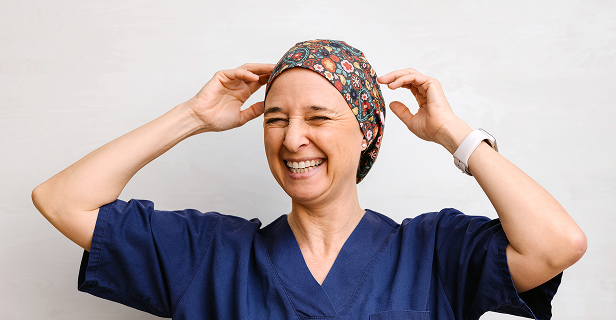
A medical professional wearing scrubs smiles while adjusting their protective cap