

Restoring Sight, One Lesson at a Time

San Diego Eye Bank’s learning program instills purpose, ensuring every procedure and conversation honors donors and patients.

San Diego Eye Bank
Shahri Jones
Creator of San Diego Eye Bank's training program
MISSION

To restore sight and end blindness

INDUSTRY

Ocular health

HEADQUARTERS

San Diego, CA

FOUNDED

1959

LEARNING AUDIENCE

Employees

Restoring sight
A

t San Diego Eye Bank, every tissue recovery, transplant, and donor family conversation must be grounded in thoughtful training. From surgical protocols to regulatory compliance to the delicate art of speaking with grieving families, the organization’s learning program teaches more than just procedures. It instills purpose.

“We have a very specific way that we go about our processes to ensure positive surgical outcomes, legality, and the care and dignity of families,” says Shahri Jones, the creator of San Diego Eye Bank’s training program. “When learners understand the why behind those processes, lessons have an even bigger impact.”

Jones first joined the eye bank as a college student, often waking before dawn to deliver donated eye tissue to hospitals across California.

“The mission really stuck with me,” she says—so much so that she returned years later to lead the development of the organization’s training program, which now supports both domestic and international teams.

A significant online component, says Jones, has made it possible for the eye bank to scale training without sacrificing quality, comprehension, or human connection.

“E-learning has allowed us to standardize our content, expand nationally and internationally, and made us less reliant on in-person trainers so we can reach more people,” she says.

“We have a very specific way that we go about our processes to ensure positive surgical outcomes, legality, and the care and dignity of families,” says Shahri Jones

A gloved hand picking up a blood sample from a tray of vials
A global responsibility

Globally, there are 12 million people people currently waiting for a corneal transplant. But in the U.S., there is no waiting list thanks to a well-organized eye banking system and abundance of ocular tissue. That surplus enables the U.S. to provide 85 percent of the world’s donated corneas, making its eye banks vital to global restoration of sight.

“Our goal is not only to train employees on how to do their job, but to teach them how their job impacts patient outcomes globally,” says Jones. “Technicians, distribution coordinators, family services coordinators—they all have an incredibly important role in restoring sight around the world.”

12M

people worldwide currently waiting for a corneal transplant

85%

of the world’s donated corneas are provided by the U.S.

View the story as a PDF
Download PDF
Our
goal
is
not
only
to
train
employees
on
how
to
do
their
job,
but
to
teach them
how
their
job
impacts
patient
outcomes
globally
Shahri Jones, the creator of San Diego Eye Bank’s training program
Comprehensive, empathetic training

The eye bank’s training program blends hands-on practice with self-paced, multimedia digital learning. Courses cover the technical—how to perform delicate recoveries or navigate data systems—and the deeply human, including how to guide families through a donation decision with care and clarity.

“We deal with extremely sensitive material and moments,” says Jones. “From the donor family to the transplant recipient, every part of the process needs to be handled with respect and consistency.”

Thanks to the eye bank’s approach to learning, its trainers report that learners are more prepared when it comes to the hands-on portions of their training. “They know the questions they want to ask, they’re thinking critically already, and the instructor sign-off timeline is shortened,” says Jones.

Training also plays a key role in raising public awareness, an ongoing challenge in eye donation. A lack of clarity around the donation process can cause fear, confusion, or hesitation for families faced with loss.

Training plays a key role in raising public awareness for eye donation.

“The eyes carry particular meaning—they’re the windows to the soul, as they say,” says Jones. “Having a team of people that knows how to start the conversation around eye donation in a sensitive, respectful, and informative way is paramount to our culture and our mission.”

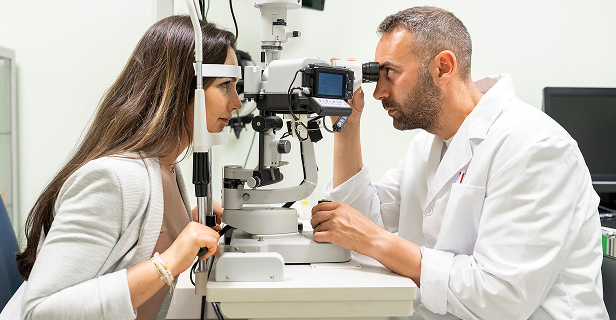
A medical professional examines a patient’s eyes with an ophthalmoscope